
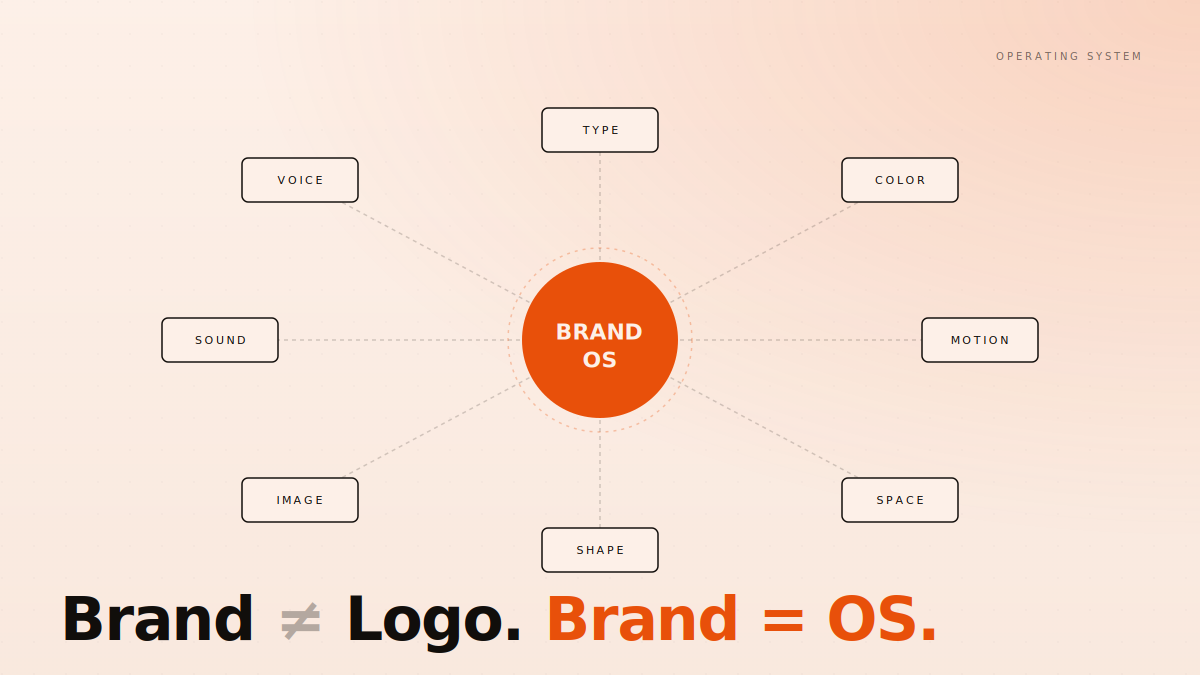
Here is a sentence we say almost every week to a new client: your logo is not your brand. They usually push back. Then two months later, when their new social manager makes graphics that do not match the website, they understand what we meant. Brand is not the mark. Brand is the system that decides everything underneath.
01 The mistake almost every founder makes
A founder gets some money or some traction. They want their company to feel real. They Google “branding”, hire a freelancer, get a logo, a colour, and a font. The freelancer hands over a folder. The founder feels good for two weeks.
Then the inconsistencies start. The Instagram designer uses different fonts. The slide deck has a different blue. The email signature looks nothing like the website. The agency-built ad campaign uses imagery that feels off-brand but technically follows the “guidelines.” Six months in, the brand has fragmented into a dozen styles, and none of them feel like the same company.
This is not a logo problem. This is a missing system problem. The logo work was fine — it was just never the point.
02 Brand as Operating System — the framing that fixes this
Think of your brand the way you think of an operating system. The visible icons are the logo, the splash screen, the wallpaper. Most of the work, though, is invisible: how files are organised, how keyboard shortcuts behave, how the system handles errors, what fonts it uses by default. The visible parts only feel right because the invisible parts hold them up.
A brand operating system has the same structure. There are eight modules underneath the surface, and your logo is one element of one module. Build the eight, and any new touchpoint — a tweet, a packaging design, a hire’s onboarding deck, a product page — clicks into place without you having to micromanage it.
03 The 8 modules of a brand operating system
Every brand we have ever built can be described in these eight modules. Some brands lean heavier on a few of them — a music label cares more about Sound, a luxury watch brand cares more about Image — but all eight need at least a documented opinion.
-
01
Voice — how you write, end to end
The single most under-built module. Voice rules cover tone, sentence length, the words you use, the words you refuse, how you handle bad news, how you handle good news. A real voice guide is not three adjectives. It is twenty before-and-after examples and a list of phrases you never say.
-
02
Type — the font system, with rules
Two fonts maximum for most brands — one display, one text. Sometimes a third for technical labels. Then rules: when to use which, sizes for each role (hero, H1, body, caption), and the licence so your team does not pirate it accidentally.
-
03
Colour — with roles, not just hex codes
Hex codes alone are not a colour system. Each colour needs a role: this is the action colour, this is the background, this is what we use for warnings, this is for success. Without roles, every new designer reinvents the palette and your brand drifts orange in March and blue in June.
-
04
Motion — how things behave
Motion has become identity. The way Apple eases its transitions is part of Apple. Document your easing curves, your durations, the shape of a hover, the feel of a page transition. If your motion is silent in the brand book, it will be loud and inconsistent in the product.
-
05
Space — how you use empty room
Two brands can have the same logo and font and look totally different because one breathes and the other crowds. Space rules cover margins, padding, line-height, what density of information feels right. Generous brands and economical brands both work; pick one and stick to it.
-
06
Shape — the visual language
Are your corners sharp or rounded? Do you use circles, bars, triangles, ribbons, blobs? Is your iconography line-based or filled? Most brands have a recognisable shape vocabulary even when nobody on the team has named it. Naming it makes it teachable.
-
07
Image — photo and illustration style
What do your photographs look like? Lit how, shot from where, edited in what direction? What kind of illustration is on-brand and what kind is not? This is the module where stock photography ruins the most brands. You need a written rule, not vibes.
-
08
Sound — if you have audio
Skip if you do not ship audio. But if you have a podcast, a YouTube channel, a product UI with sounds, a phone on-hold loop, then sound is part of your brand and needs rules. A 4-second sonic logo plus voice-over guidelines is enough for most.
04 What this looks like written down
A real brand operating system, documented properly, is somewhere
between a 30-page PDF and a small website. We tend to build the
small website — a private site at brand.yourcompany.com
with one section per module, examples for each, and download links
for fonts, colours, and assets. It does not have to be designed
beautifully. It has to be searchable.
The test for a finished brand OS: hand it to a designer who has never worked with you. Ask them to make a banner for a new product launch. If they can make something that looks like your brand without asking you a single follow-up question, the system is working. If they have to ask — what font, what blue, what tone — the system has gaps.
05 Why this compounds (and logo work does not)
A logo done well lasts ten years. A brand operating system done well saves your company money every single week for those ten years. Each new hire onboards faster. Each new touchpoint takes less back-and-forth. Each external agency you hire needs less hand-holding. The system pays for itself within the first year, then keeps paying.
Logo work is a one-time asset. Brand OS work is an investment that compounds with every person who uses it.
06 The cheap way to start, if you cannot afford the full project
Not every founder can drop $50,000 on a brand OS. Fair. Here is the cheap version that gets you 60% of the value:
- Open a Notion or Google Doc page. Title it Brand OS — v1.
- Write one short section per module. Voice gets ten do-and-do-not phrases. Type names two fonts and where each goes. Colour lists three to five hex codes with a role next to each. Motion writes two sentences on how transitions should feel. Same for the rest.
- Add a link to your logo files. Add a link to your fonts. Add a link to your colour values in CSS-variable form for developers.
- Share it with your team. Tell them: when in doubt, check this doc, then ask. Update it whenever a real edge case comes up.
That document is your brand OS v1. It is not pretty. It does the job. When you have budget, hire a studio to take it from v1 to v3, with examples, downloads, and the kind of polish that makes external partners take you seriously.
We build brand operating systems, not just logos.
If your brand falls apart every time a new designer touches it, you do not need another logo. You need the system underneath. We can build that with you in 4-6 weeks for most engagements.