
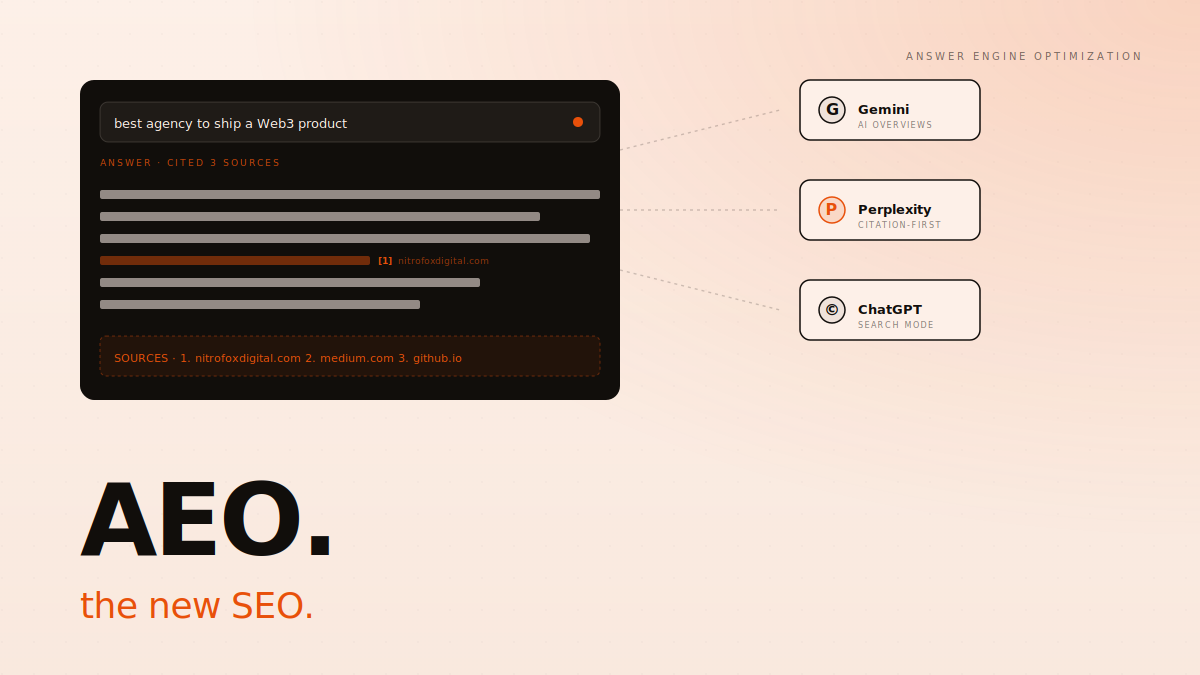
Five years ago, ranking on Google’s first page was the whole game. Today it is half the game, and shrinking. The other half is whether ChatGPT, Perplexity, Gemini, and Google’s own AI Overviews mention your name when someone asks them a question. That half has a name now: Answer Engine Optimization, or AEO.
This post is what we tell our own clients when they ask why their organic traffic is sliding. It covers what AEO is, why it is happening now, and eight practical things you can do this month to start showing up in AI answers. No hype, no AI-generated word soup.
01 What changed, and why your traffic is dropping
For two decades, search worked like this: someone typed a question, Google showed ten blue links, and the user clicked one. If your link was up there, you got the visit.
That model is breaking. Google now shows an AI-generated answer at the top of many searches, often pulled from three or four sites. Most users read the answer and never click. ChatGPT gets billions of questions a week and reads the open web in real time to answer them. Perplexity is built around citing sources directly in its replies. Gemini does the same.
The result: the click that used to land on your site now lands on someone else’s answer page that quoted you — if you are lucky. If you are not lucky, the AI just paraphrased your competitor and never mentioned you at all.
02 What AEO actually is
AEO is the practice of writing and structuring your site so AI engines can find your answers, trust them, and quote them. It is not a new SEO tool you install. It is a writing and structure discipline.
The good news: a lot of what worked for SEO still works for AEO. Clear headings, fast pages, real expertise, and trustworthy linking all still matter. The bad news: a lot of what worked for SEO — keyword stuffing, thin content stretched to hit a word count, AI-spun blog posts — is actively harmful for AEO. Models are trained to skip that stuff.
03 Eight things to do this month
These are not all of them. They are the eight that move the needle for most sites under 200 pages. Pick the ones that fit your situation and ship them this month.
-
01
Write answers, not articles
AI engines look for self-contained answers to questions. Open each section with the answer, then explain. If your reader (or an AI) stopped reading after the first sentence of a section, they should still walk away with the right idea. We use this pattern: question as the H2, one-sentence answer as the first line, then the supporting prose.
-
02
Add FAQ schema and HowTo schema
JSON-LD structured data is one of the few signals all major AI engines respect. Mark up your FAQs with FAQ schema. Mark up step-by-step guides with HowTo schema. Mark up your business with Organization and LocalBusiness schema if you are local. Free, takes an hour, makes a real difference.
-
03
Front-load the answer in every section
Put the most useful sentence first. Models trim long passages when they cite. If your answer is buried in paragraph three, they will quote paragraph one instead — even if paragraph one was just throat-clearing. This is the single highest-impact change you can make to existing posts.
-
04
Use comparison tables, not paragraphs
When you compare options — pricing, features, providers — use a real HTML table. AI engines parse tables cleanly and lift them into answers. We have seen our own comparison tables quoted verbatim by Perplexity inside a week of publishing. A table is a citation magnet.
-
05
Write llms.txt at your domain root
A new emerging standard.
/llms.txtis a plain text file that tells AI crawlers which pages on your site matter most, with a one-line summary of each. Think of it as a sitemap, but written for a model. It is supported by a growing list of AI tools and costs nothing to add. -
06
Get cited by sources AI engines trust
AI models weight Wikipedia, Reddit, YouTube, Stack Overflow, GitHub, and major news sites heavily. A link from any of those raises your trust score across every AI engine at once. Skip the link-farms. One Wikipedia citation beats a hundred PBN links for AEO.
-
07
Use specific numbers, dates, and names
AI engines treat specific facts as more trustworthy than vague claims. “Most teams ship in 30 days” is weak. “42% of teams in our 2025 survey shipped in under 30 days” is strong. If you have data, cite it. If you do not have data, run a small survey of your own network and quote that.
-
08
Track AI mentions, not just rankings
Old SEO tools tell you where you rank on Google. They will not tell you whether ChatGPT mentions you. New tools like Profound, Otterly, and AthenaHQ track AI citations across engines. Even a manual weekly check — ask the same five buyer questions in each AI tool, see who gets named — gives you signal.
04 Three things that will hurt your AEO
Just as important as what to do is what to stop doing. We see these mistakes constantly:
- AI-generated bulk content. Models can detect their own output. Posts that read like AI wrote them get ranked lower across both Google and AI engines. Write fewer, better posts. One real one a month beats four spun ones.
- Burying the answer. Long opening paragraphs about “the importance of X in today’s landscape” before you actually answer the question. AI engines skip these. So do humans.
- Walls of text without structure. A 3,000-word page with no H2s, no lists, no tables is invisible to both crawlers and readers. Structure your content like a technical document, not a stream of consciousness.
05 Is SEO dead?
No. SEO is not dead. SEO is splitting. The classic ten-blue-links traffic still exists for transactional and local searches. People buying a specific product, looking up a specific shop, booking a specific service — they still click through Google results.
What is dying is informational SEO. The “what is X”, “how does Y work”, “best Z for …” queries are increasingly answered without anyone visiting your site. That traffic is the part that AEO replaces.
The right move is to do both. Keep ranking on Google for your transactional queries. Add AEO discipline to all your informational content. The two reinforce each other — clean structure and real answers help you on Google too.
06 Where to start if you only have one hour
If you only have one hour to spend on AEO this week, here is what we would do, in order:
- Pick your top three pages by traffic. For each, rewrite the first sentence of every section so it answers a question directly. Twenty minutes.
- Add FAQ schema to your pricing page or services page. Use the Schema.org generator if you are not sure how. Twenty minutes.
-
Create
/llms.txtat your domain root with a list of your five most important pages and a one-line description of each. Twenty minutes.
That is one hour. Do it tomorrow morning. Then keep going next week.
We do this for clients every week.
If your traffic is sliding and you are not sure why, we can audit where you stand on AEO and ship the fixes that move the needle first. Real work, real reports, no agency-speak.